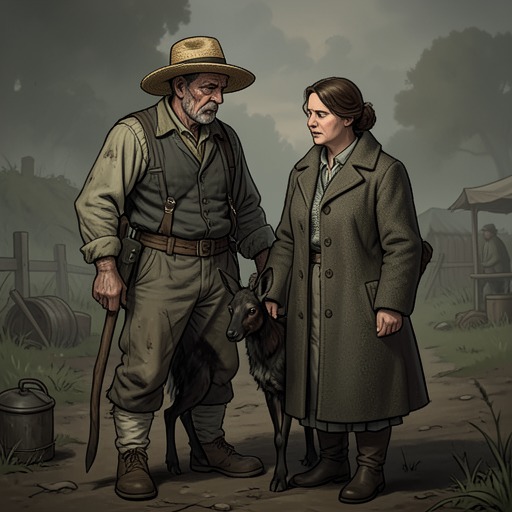
Terry Watson
All Creatures Great and SmallTerry Watson is a young farmworker and small-scale stock owner whose care for a sick cow reveals the strain and commitment behind his rural life. His episode centers on a difficult case of summer mastitis: despite a poor prognosis and a night spent tending the animal, he must return to his paid work the next morning. The story presents his devotion not as a grand declaration but as hours of repeated, practical labor undertaken alongside the work and family responsibilities that already fill his life.
Identity and Circumstances
In his early twenties, Terry works for other people and then comes home to tend his own small collection of stock. He has a wife and a small baby, and keeps two cows, a few pigs, and hens. Those animals matter materially: the account notes that they make a substantial difference to a household living on thirty shillings a week. Terry’s farming is therefore not simply a private interest or an extension of his day job. It is additional work on which the family’s limited means depend.
The contrast between his employment and his own animals shapes the episode. Terry is described as someone prepared to labour all day for somebody else, then begin again with his own stock. His resources are modest, but the time and attention he gives the cow are not. The narrative places his care within the ordinary economics of farm life, where a small number of animals can be important to a household and where tending them must be fitted around paid work.
The Mastitis Case
At about seven in the evening, when the veterinarian thinks the day’s visits are finished, Terry calls about one of his cows. It is mid-July, earlier than the usual season for summer mastitis, but the condition becomes common later in the summer; many farmers call it August Bag. The outlook is poor. The disease is described as difficult to cure and likely to cost the cow a quarter of her udder, with a risk of death in some cases.
Terry stands beside the cow with a grim expression and runs a hand along her back. The veterinarian offers an injection and instructs him to strip the affected teat as often as possible, while making clear that recovery is uncertain. The treatment places much of the continuing care in Terry’s hands: a single veterinary visit cannot replace the repeated work the cow needs. Terry appears relieved to have something he can do. He fetches an old bucket, takes a milking stool between his legs, and crouches beside the animal to begin.
A Night of Care, and the Return to Work
When the veterinarian visits again the next morning, after being called to a case of milk fever, Terry is still in the little two-stall shed. He is in the same position as the night before, tending the infected teat, his eyes closed and his cheek resting against the cow’s flank. He starts when spoken to, as though waking from sleep. The scene makes the duration of his care visible: the instruction to repeat the treatment has carried him through the night, rather than ending when the veterinarian leaves.
Terry’s wife arrives at the shed holding their baby. Her presence brings the household into the scene and underscores the effort already being made to keep the cow under care. When the veterinarian acknowledges that Terry has stayed with the animal, his wife points out that he has been working in this way around the clock. Terry does not continue indefinitely. He straightens his shoulders and says he cannot stay: he has to go to his job and is already late. His departure is not evidence of indifference, but the point at which care for his own stock collides with the paid labor on which the family also relies.
Narrative Significance and Limits
Terry’s character is drawn through concrete acts rather than an extended biography: the evening call, the old bucket, the stool, the repeated treatment, and his unchanged position in the shed at eight the following morning. These details show both his willingness to persist and the limits imposed on that persistence by work and poverty. His wife’s presence adds a second dimension to the care around the cow, while Terry’s need to leave establishes that devotion cannot suspend the household’s other demands.
The episode does not state whether the cow ultimately recovers. Its significance lies instead in the effort made under an uncertain prognosis and in the pressure placed on a young family whose few animals contribute materially to its livelihood. Terry emerges as a capable, determined caretaker, but not as someone free to devote unlimited time to care: the same working life that sustains his family also requires him to leave the shed.